
Gaussian splatting for products and retail spaces
Gaussian splatting turns a real capture, or CG renders of a 3D model you already own, into a photoreal scene that opens in the browser and on a phone.
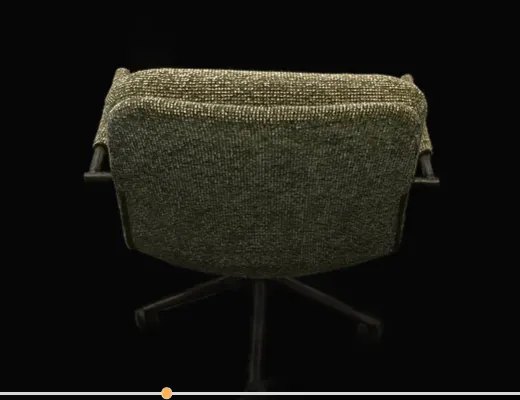
What gaussian splatting is
Gaussian splatting is a reconstruction technique: it takes photos, video or renders of a 3D model and returns a cloud of points with colour and shape that reproduces the scene as it looks.
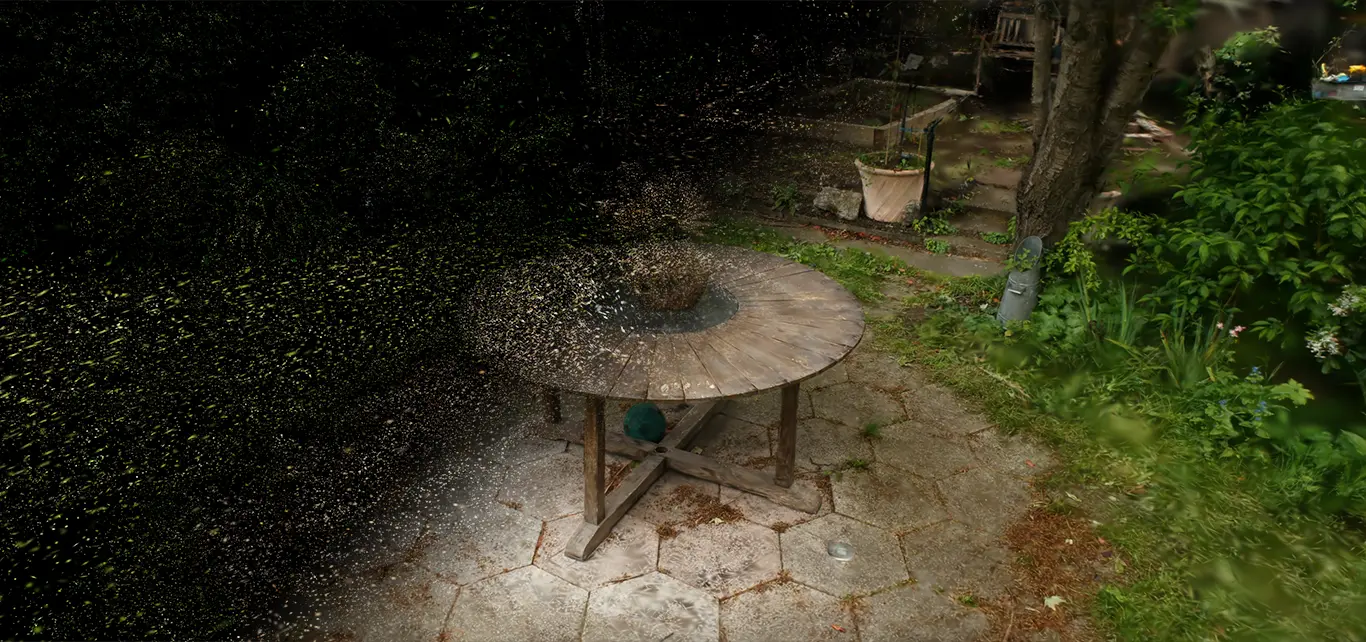
Who it is for
It pays off when the scene already exists and has to be shown with a balance between fidelity and optimisation. If a 3D model is too heavy, a splat can be generated from it.

Splatting, photogrammetry or a 3D model
All three produce a 3D scene and they do not compete at the same job. Photogrammetry rebuilds a textured mesh, a 3D model is editable geometry, and splatting is a highly faithful visual representation with no mesh. The choice depends on whether you need to measure, to edit or only to look.
| Criterion | Gaussian splatting | Photogrammetry | 3D model (glTF) |
|---|---|---|---|
| Realism | Very high: real light and materials | High on matte surfaces | Depends on render and engine |
| Geometry | Point cloud, no mesh | Textured mesh | Editable mesh |
| Reliable measuring | No | Approximate scale | Yes |
| Reflections and glass | As seen, with artefacts on edges | Gloss breaks up | Simulated with PBR materials |
| Weight | Needs optimisation | Heavy on large scenes | Target < 5 MB per product |
| Mobile | Target 60 fps once optimised | Depends on polygon count | Target 60 fps on mid-range |
From capture to the web in four steps
Our process to digitise your products.
- 01
We capture or start from renders
We capture the information from the real product, or from renders of its 3D model.
- 02
We reconstruct the scene
We align the shots and generate the splat. Edges, reflections and areas with no coverage get reviewed.
- 03
We cut the weight
We tune the point count and optimise.
- 04
We publish on your site
Our own viewer embedded in your page.
Frequently asked questions
What is gaussian splatting used for?
For showing a real scene with photographic fidelity in a browser. It rebuilds photos, video or renders as a point-based scene. It fits product, interiors and prototypes, not measuring or editing.
Gaussian splatting or photogrammetry?
Photogrammetry returns a textured mesh and lets you measure and edit, with error. Splatting is more faithful in light and material but has no mesh. If the goal is looking, splatting; if measuring, a model.
Can I use it to sell product online?
Yes, when the product exists and the real texture is part of the argument: finishes, surfaces and fabrics. It will not switch materials or variants. That is the configurator job.
Can I take measurements from a splat?
Not reliably. The reconstruction guarantees neither scale nor accuracy, and a drawing produced from it can be wrong. If you need dimensions, we use a model built to scale.
Does it run on mobile and how heavy is it?
It runs in desktop and mobile browsers through WebGL. Weight depends on the scene and has to be optimised.
Can I start from CG renders instead of photos?
Yes. If a 3D model already exists, we render the scene from the viewpoints needed and rebuild it as a splat. You keep the render look with less weight.